Glasgow


Here’s the bird that never flew;
Here’s the tree that never grew;
Here’s the fish that never swam;
Here’s the bell that never rang.
“Glasgow is a magnificent city,” said McAlpin. “Why do we hardly ever notice that?”
“Because nobody imagines living here… think of Florence, Paris, London, New York. Nobody visiting them for the first time is a stranger because he’s already visited them in paintings, novels, history books and films. But if a city hasn’t been used by an artist not even the inhabitants live there imaginatively.”
The Scots (originally Irish, but by now Scotch) were at this time inhabiting Ireland, having driven the Irish (Picts) out of Scotland; while the Picts (originally Scots) were now Irish (living in brackets) and vice versa. It is essential to keep these distinctions clearly in mind (and verce visa).
- I stayed 3 years in Glasgow, learning to code. I miss it all the time.
- (“Learning to code” maybe sounds dreary to you - the reek of offices and bureaucracy and procurement and formal minutiae and alienated labour and goodharting CS major fools. But it wasn’t at all like that. “Becoming technical” was a spiritual matter for me, wanting to become real and understand nature and the actual causes and structure of society: i.e. technology.)
- At the time, the head of department was the formidable Chris Johnson, now chief scientific advisor to the UK government.
- Like Liverpool, it’s half-Irish. What do I mean?: A culture of craic, cheek, deflation, communitarianism, gab. (Like Liverpool, they didn’t benefit from the Irish accent.)
- Or should I say 25% Irish. At the peak, after the Famine, the city was about 25% first-generation Irish. The deportations were intense - up to 10,000 a year - but in 1901 there were still 200,700 first-gen Irish in Scotland.
- Or should I say 25% Irish. At the peak, after the Famine, the city was about 25% first-generation Irish. The deportations were intense - up to 10,000 a year - but in 1901 there were still 200,700 first-gen Irish in Scotland.
- It’s somehow the artiest place in Scotland (8 Turner Prizes out of 40) and the most violent and demotic. You can say boringly that art and crime are just both urban phenomena.
- The humour and antipretension border on repression - but it doesn’t work! It produces an artist backlash, to become more up yourself, to spite them.
- The humour and antipretension border on repression - but it doesn’t work! It produces an artist backlash, to become more up yourself, to spite them.
- It has the most asabiyah of any place I’ve lived. Which is strange when you consider the supposed ancient smouldering faux-religious spat it contains.
Most schools were still segregated by faith as recently as the ’80s. The Catholic school system is still going strong (around half of Glasgow schools, compared to 16% of all Scottish schools) but the students are “all faiths and none” now, often 50% noncatholic.
In 1923 the Church of Scotland put out The Menace of the Irish Race to Our Scottish Nationality and encouraged employers to discrminate against them. This shit lasted into the 1960s, but by the 90s deindustrialisation completely destroyed the discriminating guilds.
Some amateur notes: Glasgow’s “sectarianism” is by now more fiction than reality and more tribal than religious. (Maybe that’s the typical case - poor churchies.) “Ninety-minute bigots do not hold beliefs”.
- The spat was imported and reactionary: you can tell because the rest of Scotland is chill. Greater Glasgow got something like 90% of the great 1850s Famine migration. And they brought religious anger with them - maybe the same anger the Scots brought to C17th Ulster, coming back and rekindling. The rest of it was weird racism plus the old latent local hatred.
- “In 1795 there were only 50 Catholics in Glasgow. By 1829 there were 25,000 and in 1843 almost twice that number… In the 2001 census just over 800,000 Scots said they had been raised as Catholics”
- “In 1795 there were only 50 Catholics in Glasgow. By 1829 there were 25,000 and in 1843 almost twice that number… In the 2001 census just over 800,000 Scots said they had been raised as Catholics”
- How can they have maintained this feud for 170 years, when the rest of the country got over it long ago? Well, maybe they haven’t maintained it: My old sociology prof used to startle people by saying:
That some Rangers and Celtic fans wind each other up by falsely claiming to have strong religio-ethnic identities which are offended by the equally false religio-ethnic identities of the other side is not a reason for the rest of us to take such ritual posturing as the basis for judging the polity, society and culture of an entire country.
The sectarianism of Scotland is a myth: popular in some places but a myth nonetheless. A major survey in 2001 in Glasgow showed that many people thought sectarianism discrimination in employment was common but that none had suffered it themselves – it was something they had heard had happened to others. He leans on the lack of segregated ‘hoods and turfs (unlike say Belfast).
We’re used to small groups of thousands dictating the culture of millions - consider Rhodesia or Harvard or English public school. But that’s elites. It is less usual for a small underclass to determine a nation’s self-identity (here, as “sectarian”).
- The long madness is over. Having “no religion” doubled in the city between 2001 and now, 23% to 43%. The eventual reinvention of secularism as a stable equilibrium.
Peter McLaughlin comments
Even as the rest of Scotland pretty much never got in on sectarianism in any other way, sectarian splits in football were common. Hearts v Hibs is the most famous example, but e.g. Dundee United was originally the Irish Catholic club and Dundee the native Protestant one. Obviously this is now all completely forgotten and even Hearts v Hibs has basically no denominational valence except for vague cultural memory.
On the flipside, sectarianism in Glasgow today isn't just an 'underclass' phenomenon: it is specifically a phenomenon in the parts of the underclass who follow football. Today's Glasgow has loads of Muslim hoodlums as well as the Catholic hoodlums and the Protestant hoodlums, but they generally haven't gotten in on the sectarian 'act', _except_ insofar as they follow local football - more likely Celtic than Rangers. (Compare Northern Ireland, where any hoodlum worth his salt will be understood as either taig or prod, even if their family is from the subcontinent or wherever.)
You can also see this from a Northern Irish rather than a Scottish perspective. e.g., Derry City is, statistically and historically, a 'Catholic club', and if someone in NI wears a Derry City shirt I can make a very good guess at how they say 'h'. Ditto for e.g. Linfield on the other side. We have more than our fair share of homegrown football clubs that are useful ciphers or shibboleths for sectarian affiliation; if the Old Firm were just something that acted as a Schelling point in clashes more fundamentally grounded in sectarianism, it wouldn't have any significance in NI, we have better Schelling points ourselves. _And yet_, people still go around in Rangers or Celtic shirts in Belfast and Derry.
What Glasgow has today is, basically, a football hooliganism problem. The historical roots of the particular type of football hooliganism found in Glasgow are distinct from the historical roots of football hooliganism elsewhere, coming from the interaction of (a) actual real historical sectarian tensions in Glasgow and (b) the Scotland-wide thing of Irish Catholics having their own football teams. Nowhere else had quite the same interaction between (a) and (b), and this productive interplay has allowed the special Glaswegian type of football hooliganism to take on a life of its own, and survive even as non-football-related sectarianism in Glasgow, and football hooliganism in every other European city, have declined. The sectarian superstructure has not been causally inert, and has given a special lease of life to Glaswegian football hooliganism; but the base phenomenon is specific to football.
And - to get really sub-Marxist 'everything is a conspiracy of the bourgeoisie' on you - I might suggest that the 'it's a sectarian conflict' ideology persists because of who it's useful for. Rangers and Celtic are almost unique among European clubs in _still_ inflicting stuff on their host city like masked supporters charging at each other with weapons on one of the city's busiest shopping streets. Even less dramatic phenomena, like big council bills for cleanup and football-related criminal damage, persist in Glasgow where they don't elsewhere. You might expect a response that would impose restrictions on the clubs that fans and owners resent; but if policymakers are convinced that Old Firm problems are actually just representative of Scotland's deep and still-unpurged original sin, then their attention will be taken away from the clubs and towards bullshit 'community outreach' or whatever. Of course, convincing everyone that Scottish sectarianism is real just allows the Old Firm hooligans to continue to imbue meaning into their actions and causes the phenomenon to persist, but Celtic and Rangers fans don't really mind so much so long as they can still see their favourite games."
- The city’s most famous for being hard as fuck, but this isn’t that true anymore.
Used to be the lowest life expectancy in the UK (e.g. for 24 years running, 2001-2024) - now it’s merely the second lowest. The Glasgow Effect: Scotland is about as healthy as other European countries, if and only if you ignore Glasgow. Apocryphally, “if a man crosses the footbridge from Kelvingrove to Govan he loses 15 years.”
In 1990 about 1-2% of Glaswegians were shooting up heroin. It’s a bit lower now, though as in the rest of the world, lots moved on to pills.
People talked about murder a lot, but Glasgow peaked at 10% of New Orleans’ current rate. It also halved since 2002; still the worst in Scotland but converging. The specific tagline “murder capital of Europe 2004” seems to be made up (it was again merely the second worst).
Oldest public professional police force in the world? You’d need one.
The big gang of the 60s probably named themselves after a Hammer horror film about Chinese triads.
- Like Bristol it was at some point “second city” of the Empire.
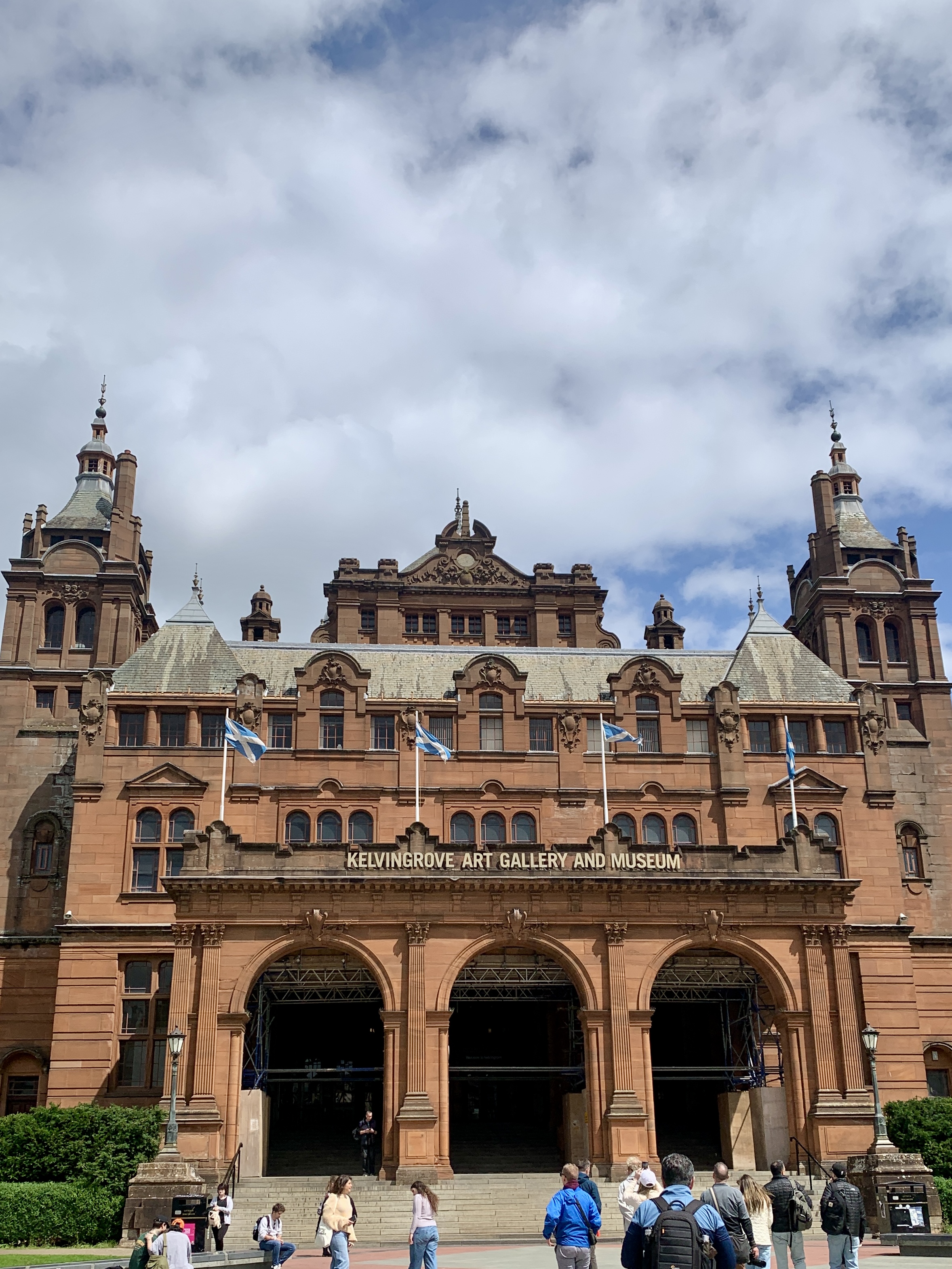
- In the C18th, Glasgow merchants controlled 40% of the American (i.e. slave) tobacco trade with Britain, more than London. The modern art gallery is now in the mansion of one of these “Tobacco Lords”.
- At the peak around 1900, Clyde shipbuilding produced ~20% of all the world’s ships.
- But between 1960 and 1990 it roughly halved in population. The New Towns (East Kilbride, Glenrothes, Cumbernauld) that received the people cleared from the Gorbals slums are basically more Glasgow. Even after this clearance, the city is still twice as dense as Edinburgh, though less than London.
- Let me ignore mere municipal boundaries and strict contiguity and call the real cultural unit Mega-Glasgow:

re-including these very similar and often directly descended people gets us back to Glasgow’s peak population of 1.2m and then some. Irishtown, UK.
“Apartments in tenement buildings in both cities are now often highly sought after, due to their locations, often large rooms, high ceilings, ornamentation and period features.”
- It remains pretty red.
- After 1870 the “co-operative movement” built a substantial alternative economy, with 20% of the entire Scottish population as members in 1930. It made food, furniture, clothing, cleaning products, medicine, 200,000 bombs. The SCWS had its own tea plantation in Sri Lanka. Supposedly three-quarters of all funerals in Scotland went through them. Hard to say what fraction of GDP this was; 5%?
- Glaswegian Keir Hardie was the first ~Labour MP in the history of the world.
- This is a fun list - see the shift starting 1931.
- It’s extremely pro-immigration, with 47% supporting more (compare Scotland’s 38%, England’s 22%, Bristol’s 55%). Note though that the flow of international migration to Scotland is 20x lower than England.
They’re completely mad for gigs, twice more per capita as anyone else in the world. Not sure if this data is any good but it chimes. (The second giggiest city is Dublin, but Glasgow’s dominance still begs for a second explanatory variable besides “they’re Irish”.)
Scotland defines itself partly by negating whatever England is; in the mind of Glasgow, Glasgow is the Scotland of Scotland, Edinburgh the England of Scotland. Glasgow was 54% “Yes” to Scottish independence from England; Edinburgh was 39%.
- Edinburgh gets more credit for the ‘Enlightenment, but Smith, Hutcheson, Black, and Watt were ‘weegies - the economic and chemical side of things, which you might think ended up being the more important half.
- There’s a claim that Hutcheson was the first lecturer to switch to English from Latin.
- Notably “the Scottish Enlightenment” is a pretty new coinage. The uni’s own beloved Alexander Broadie has a lot to do with that.
So Chicago is a pretty good comparator: heavy, decayed, disorderly, red, beautiful, musical, fun. Or Pittsburgh.
- Moving to think that a fundamental physical unit is named for a little tributary of the river.
The best of Glasgow
Art: Alasdair Gray. (Rennie MacIntosh is a great writer and a distinctive draughtsman, but monotonous.) See also.
Poet: Crichton Smith or BV. People usually say Edwin Morgan. Edwin Muir’s whole family died on moving from Orkney to Glasgow.
Novelist: Alasdair Gray. Smollett.
Comics: Grant Morrison.
Art music: Eugen d’Albert. Thomas Wilson. Glasgow Improvisers Orchestra. Harry Gorski-Brown.
Popular music: Maybe the city’s main thing. In the top 5 music cities in the UK, I’d argue. Donovan, Arab Strap, Belle and Sebastian, Mogwai
Label: Chemikal Underground or Rock Action
Philosopher: Francis Hutcheson. Will MacAskill. (Alasdair MacIntyre is the famous one, and beloved, but I don’t know what to make of him.)
Scientist: Kelvin, Joseph Black
Economist: Gregory Clark. (Smith was there for 10 years but despite the branding push I don’t buy he’s theirs much.)
Comedian: Limmy. (Honourable mentions: Stan Laurel, Rab Florence, Jerry Sadowitz, Armando Iannucci.)
Philanthropist: William Burrell
Folk hero: John Maclean
Eccentric: A.E. Pickard
Crank: RD Laing
Ranter: James Kelman
Blogger: Peter McLaughlin
Infohazard: There’s a Dali painting in the Kelvingrove that drives a certain type of person mad.
Director: Bill Forsyth or Lynne Ramsay
Film: Ratcatcher. Honorable mention: Death Watch, Orphans, Wilbur Wants to Kill Himself, Under the Skin, Beautiful Creatures (2000), Unleashed.
TV: Limmy’s Show; Still Game; Burnistoun; VideoGaiden.
Actor: Robbie Coltrane I guess.
Videogame: Observation
Entrepreneur: Collins? Alan McGee? McGill? Scrooge McDuck?
Venue: Mono
Restaurant: Mono or Usha’s. (Oddly the Rishi’s is nowhere near as good as the Aberdeen one.)
Pub: Lock 27 or the Pot Still
Delicacy: munchie box
Walk: Pollok Country Park. Or, outside, the Kilpatrick Hills and the Loup of Fintry.
Building: Maybe the Anniesland gasometers tbf.
Street: Ashton Lane is barely a street but.
Church: St. Vincent Street; disused. Òran Mór. the Gurdwara is garish but impressive and lunch is free.
Library: Mitchell.
Bookshop: Thistle Books or Young’s Interesting Books
Cafe: Tchai Ovna is shut now.
See also
- Bristol
- Taipei
- Aberdeen
- Tallinn
- Prague
- Glasgow on Film
- https://alfierobinson.substack.com/p/robinson-and-the-problem-of-glasgow
- https://neilscott.substack.com/p/brutalist-glasgow
- https://strangeexiles.substack.com/
- https://richardcapener.substack.com
- https://theglasgowwrap.substack.com