A Life Really Worth Living
This class is about a fatal trap that lies in wait for the brilliant but unwary young person: success; other people’s definitions of success. I have seen your CVs. They are too long. You are in danger.
What do we mean by success
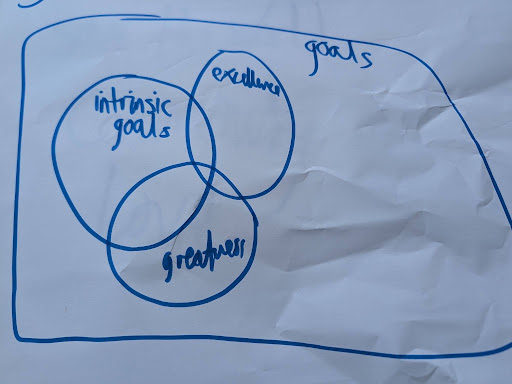
- “Excellence”: Ordinary success. Pejorative. Default. extrinsic rewards. money, status, fame, Ivy League degree, fancy title, proximity to power
- “Greatness”. What do you think of the operational definition “Doing something no one has ever done before?” Indeed: we need “instantiating of a great tradition” as well
- Self-fulfilment. whatever you intrinsically want including all of the above iff they are intrinsically valuable.
These three things are connected! Becoming the world’s greatest violinist is great, and is often rewarded with the laurels of excellence, and hopefully is also quite fulfilling (though top performers are often marked by constant dissatisfaction). Excellence gives you resources. Greatness is often quite fulfilling (because it’s rare to keep up the necessary motivation without intrinsic fulfilment as an intermediate reward).
A simple hack is to see if anything is in the triple intersection for you.
Interactive: 1. What do you want in life? (5 mins)
5 minutes silent writing please.
While you’re thinking I will list some examples.
Scientific discovery, art, parenting, happiness, freedom, chill, Enlightenment, fun, safety, doing something genuinely new, retiring early, saving the world, varietymaxxing. Abundance, achievement, adventure, affiliation, altruism, apatheia, art, asceticism, austerity, autarky, authority, autonomy, beauty, benevolence, bodily integrity, challenge, collective property, commemoration, communism, community, compassion, competence, competition, competitiveness, complexity, comradery, conscientiousness, consciousness, contentment, cooperation, courage, creativity, crime, critical thinking, curiosity, democracy, determination, dignity, diligence, discipline, diversity, duties, education, emotion, envy, equality, equanimity, excellence, excitement, experience, fairness, faithfulness, family, fortitude, frankness, free will, freedom, friendship, frugality, fulfillment, fun, good intentions, greed, happiness, harmony, health, honesty, honor, humility, idealism, idolatry, imagination, improvement, incorruptibility, individuality, industriousness, intelligence, justice, knowledge, law abidance, life, love, loyalty, modesty, monogamy, mutual affection, nature, novelty, obedience, openness, optimism, order, organization, pain, parsimony, peace, peace of mind, pity, play, population size, preference fulfillment, privacy, progress, promises, property, prosperity, punctuality, punishment, purity, rationality, reliability, religion, respect, restraint, rights, sadness, safety, sanctity, security, self-control, self-denial, self-determination, self-expression, self-pity, simplicity, sincerity, social parasitism, society, spirituality, stability, straightforwardness, strength, striving, subordination, suffering, surprise, technology, temperance, thought, tolerance, toughness, truth, tradition, transparency, valor, variety, veracity, wealth, welfare, wisdom.
Class share their examples
Interactive: 2. What’s missing in the world? (3 mins)
Same question rotated outwards. 3 minutes silent writing please.
Class share their examples
Quiet desperation
Interactive: Of the adults you know personally, how many work on stuff they find interesting? Great? How many are overall contented?
Right, I’m glad we agree.
On average the world has a way of leading us away from greatness and self-fulfilment, even among the doubtless capable and unusually well-resourced adults in your unusual lives. There is a deep gravity well which leads towards dissatisfaction and mediocrity. It is actually deeper for talented people like you. But you also have more thrust to escape with.
Why?
Fear
For most people, uncertainty is painful → ladders. Another way of saying this: for most people, perfect freedom is quite horrible. 25-50% of PhD students drop out, and that’s among the subsets of humanity most hardened to uncertainty.
You are born. You gain awareness and skill. You are faced with a huge practically-infinite-dimensional space of possible lives. How do you search such a thing?
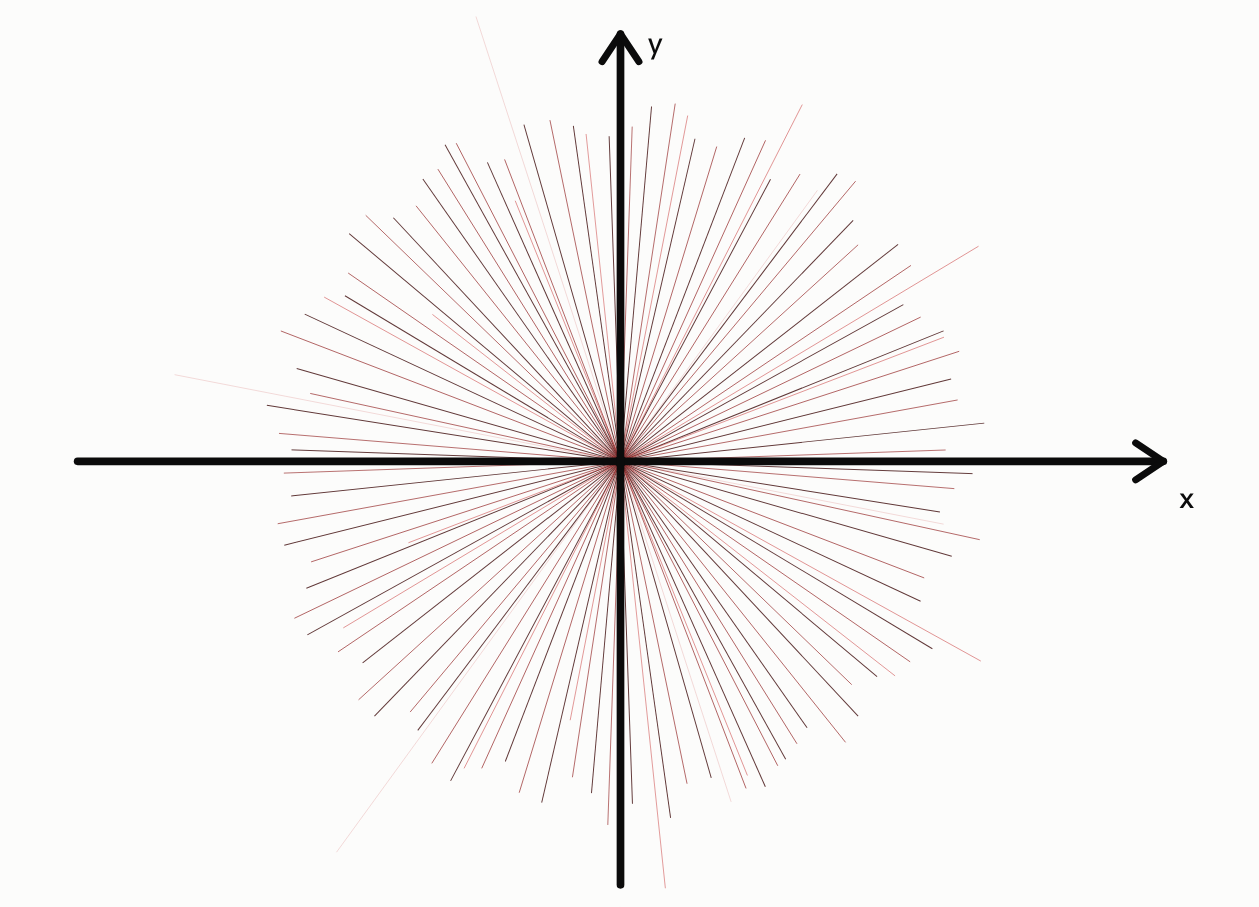
Interactive: Well, how do you solve a problem with too many dimensions?
- Many good suggestions like sampling, gradient descent, searching within a promising subspace, assuming linearity, using evolved or learned heuristics.
- Sampling actually fails in theory but works in real life.
Yes. However, I claim that the most common algorithm is instead pick a single socially-reinforced axis and live within it.
I call artificially flattened, fixed, socially-reinforced paths through life ladders.
From the perspective of reducing fear, they have many nice properties:
- Precomputed
- Static
- Low-dimension. Often close to 1 dimensional (promotion through the ranks)
- Piecewise
- Unambiguous
People get scared or fail to search for themselves so they climb ladders.
- Corporate ladder - L7 ($1m a year), C-level, first class flights, PA, suits
- Government ladder
- Academia ladder - how many of you know how tenure works?
- Nonprofit ladder - grand speeches and unbelievable inefficiency
- Startup ladder - TKS
- EA ladder
- Radical dropout off-grid ladder
- The ESPR ladder
Interactive: Which ladder are you most at danger of climbing?
I am sorry to start talking about jobs, but the fact is that your choice of job is probably the second-most influential decision on your ability to achieve your intrinsic and especially extrinsic values. (After #1: who you choose to spend time with.)
How do people spend their lives?
Let’s look at the distribution of jobs in the global population; among “elite” undergraduates (R1s); among people like you (ESPR alumni); and among this year’s ESPR instructors.
| Global | Elite undergrads | ESPR alumni | ESPR 2026 instructors | |
|---|---|---|---|---|
| Academic | 0.40% | 30% | 22% | 8% |
| Unemployed | 5% | 2% | 10% | 15% |
| Self-employed | 25% | 10% | 12% | 22% |
| Large corporation | 15% | 25% | 18% | 8% |
| Small business | 39% | 8% | 10% | 8% |
| Startup (equity) | 5% | 10% | 20% | 16% |
| Charity | 1% | 10% | 6% | 15% |
| Government | 10% | 5% | 2% | 8% |
Despite being 0% full-time academics, crucially, we are also 23% PhD holders plus 23% PhD dropouts. We know academia well. Crucially we are also 50% full-time researchers. We love research. What does this gap between 0% and 46-50% tell you about us? About academia?
Now consider the instructors distribution. i.e. 70% of us rejected ladders. This should make you think both “ladders bad” and “ESPR are weirdos who I maybe shouldn’t listen to”. Staff differ from the global population at p=0.002. But you already knew that.
That said, by KL-divergence, Jensen-Shannon and total variation, ESPR alumni and staff are the closest fit. So you just need to work out if you’re not an atypical alum to listen.
Path dependency
- Golden handcuffs. “Accustomed quality of life” as one-way ratchet.
- “Too old” -> can’t retrain
- “I should get a job in my major otherwise it’s a waste”
- Tenure bandwagoning → death
- Dependents → need money
Status
You and I are apes. That is to say, we are intensely social and intensely status-seeking beings. Most of what we do has some component of looking good and competition and conformity. This is not intrinsically bad. But we go a little crazy when we are starved of it, as young people are.
Status = doing things because other people value them
e.g. You are all overrating the extrinsic rewards of college. It probably washes out to some degree - “employer learning”.
The terrible thing - the diabolical thing - about status is that talking about it creates pressure towards it. No way around it. I’m sorry. The best we can do is make intrinsic goods high-status.
Settling
To stay sane, the minds of adults look like this over the course of their lives:
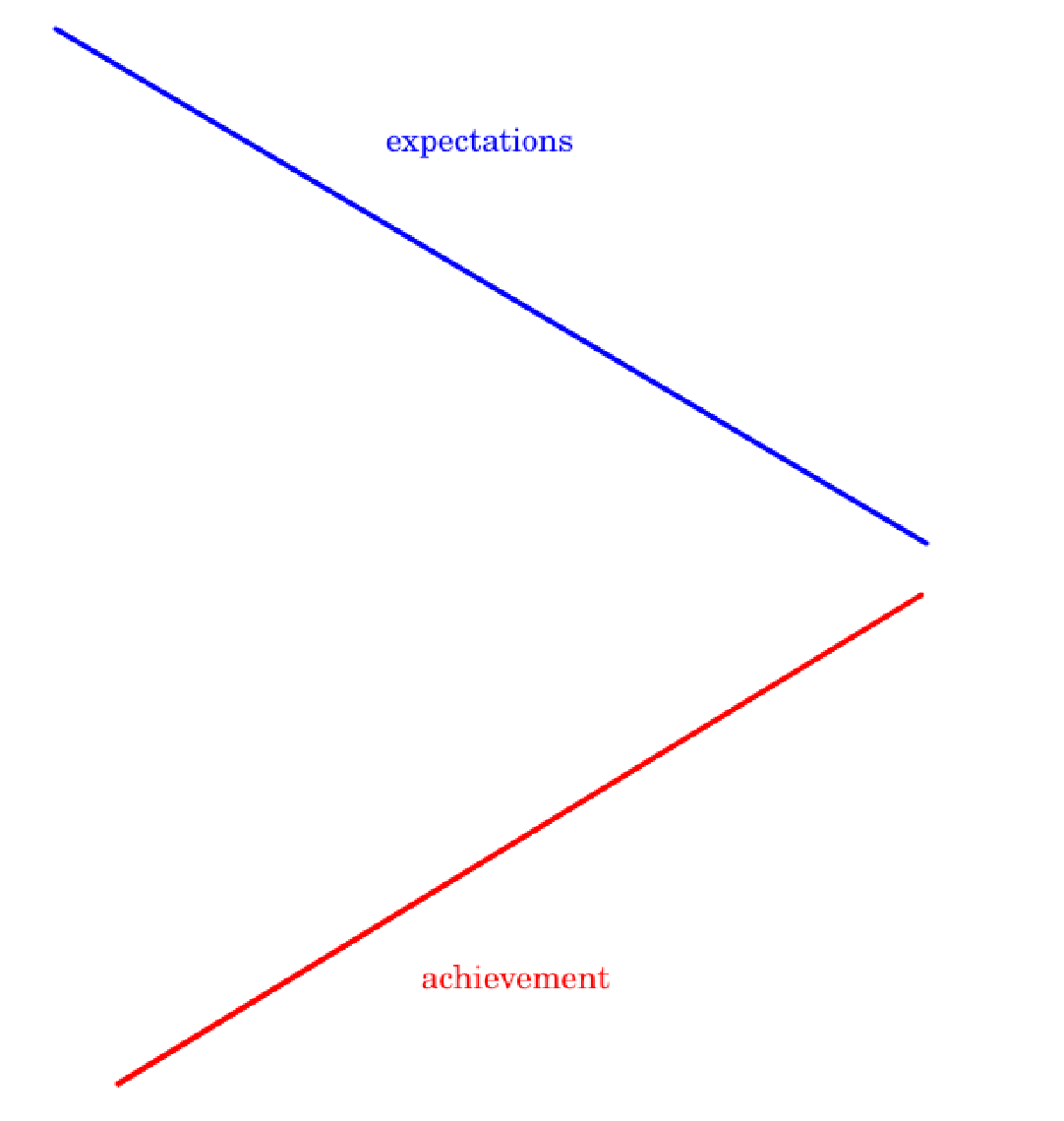
Comfort is both the goal and an enemy.
Ignorance
Ignorance of the option set
- The first time I heard of Olympiads I was 25yo.
- The first time I heard of ESPR I was 30yo.
- I put off starting a PhD for years because I assumed that PhDs needed to be smart. Actually the main predictor is pain threshold.
Permission
- Miscalibration about skill requirements
- A missing self-image: “I can do things without asking permission”
I’m the first person in my family to go to college. Grandparents all farmers. Mother a cleaner. I was also shy and depressed for a lot of the first 20 years. It took me a while to get going.
Several times in my life, people have tapped me on the shoulder and told me that I wasn’t living up to my potential.
- I was working in London finance, doing “very well”, not working very hard. But the work was meaningless and the corporation I inhabited was extremely dysfunctional. I told a researcher I met that I didn’t think I was good enough to do a PhD. He scoffed and said that I was obviously far above median.
- A bit later, I was a researcher, I was in a PhD. But no one was really paying any attention. I sent a famous public intellectual my work. He sent me $30,000 and promoted my work to millions of people. This led to me starting my company, working on incredibly fun things all the time, and never worrying about money ever again.
- At the same time, I didn’t have a circle. I had friends but no collaborators, no one who cared about the things I cared about, no one pushing me to do concrete better work. I didn’t think of myself as a leader. I went to Czechia and met this crazy bunch of researchers and meditators and programmers. It was one of the most fun weeks of my life. Some time later, they asked me to lead this camp for teenagers they run.
I was waiting for permission and was deluded about how much it takes to be great, to do actually new things.
I hope this class is the last permission you need. I hereby give you permission to live a good life in any way you choose.
the Egregores Lagrange (AKA checks and balances)
One way of viewing yourself in society is that you are a tiny mote of dust in a system of vast grinding gears. Bureaucracies want your time and obedience. Corporations want your money. Governments want your money and your obedience.
It is tragic that we need governments, that we can’t trust markets to deliver what everyone needs.
It is tragic that we need markets, that we can’t just trust government to deliver what everyone needs (let alone what they want) and to not crush the Other.
It is tragic that we need corporations, that economies of scale are so important that we must risk monopolies and cronies and skinwalkers.
It is tragic that we need bureaucracies, that the human urge for favoritism and self-dealing is so strong and ruinous that it’s worth imprisoning everyone on earth in a cage of stupid rules.
It is tragic to be forced to choose to not be free.
And yet - Who knows what a Lagrange point is? Societies are free to the extent that they create Lagrange points in between these hungry forces of gravity.
Sometimes remember this viewpoint, that society is trying to get you to do things you don’t and shouldn’t want to do.
- tame the algorithm lest it tame you
- tame the incentives around you
- tame your parents
- tame your compulsions
- tame espr
Ways to identify fake ambition
Riff on this.
Ways money makes things worse
Riff on this
You have options
Student: “but we have no choice, we need to pick a ladder”.
No. Options exist always.
- You could not have a job. Bohemians trade income and security for freedom. My brother lives on about $5000 a year.
- You do not need credentials to do things. The European CDC runs me and my friend’s code. We are not epidemiologists.
Most old or large orgs are horribly ladderified. But conversely new things are not!
So start something!
- New companies are sometimes great
- New government agencies are often great
- New artistic scenes are alive and filled with real ones
What is the good life?
- ability to fulfill your intrinsic values
- ability to resist centres of wealth and prestige if you choose
- ability to minimise bullshit
- ability to endure discomfort in service of a goal if you actively and reflectively choose to
What can ESPR do for you? What can you do for the above this week? (5 mins)
- help finding who to contact (profs, founders, anons)
- help writing cold emails
- help starting a blog and plugging it
- help calibrating ambition level correctly (usually up)
- help finding funding
- help developing mastery (maths, forecasting, public speaking, whatev)
- scholarships
- detailed research feedback
- finding collaborators
You fail this class if you do not ask for something
Damage control
Most useful work in the world occurs inside ladders. You cannot scale without a ladder.
The world would not function if everyone just did what they wanted. Most unpleasant jobs nonetheless help the world, sometimes enormously – consider the example of Prime Minister of the United Kingdom. My point is that you need the ability to steer away from centers of wealth and prestige if you want to.
Interactive: who is planning to climb a ladder?
One thing you might take away from this class is that you need to do bigger things, put even more pressure on yourself. No! I am telling you that you have that option, you are more powerful than you think. You should view this as a PARTIAL argument for trying an independent life. The forces that suggest you climb ladders are legion and as soon as you leave ESPR; they will come crashing back in full force.
Ladders are useful. Most useful work takes place inside them, despite them. You can’t scale without a ladder Do not let me tell you what to do.
Most work makes the world better in a small and quiet way. This is beautiful. Mihaly once worked on Google’s central TCP/IP code. He commented out one line and sped up every single web request that Google performs. If it’s a billion milliseconds saved every day, that would be 11 years of ~human life “saved” every year. He says this is likely the most valuable work he ever did for them.
Getting to L6 at Google, having 2 children, saying true things, retiring at 50, being kind. This is a lot. It is more than most humans who ever lived achieved
See also
- Escaping Flatland (2D planes instead of 1D ladders)
- ambitions
- What’s stopping you?
- Comparing up and down
- Great work