[DRAFT] Against grad school

academe is something to exorcise; it needs to be lived, for a time - but lived in order to demonstrate that it is ultimately unlivable. There is a world elsewhere.
“No insults, please!” said Pugg. “For I am not your usual uncouth pirate, but refined and with a Ph.D., and therefore extremely high-strung.”

You sometimes see people say that “Abhinav won his PhD in 2019”. This is a solecism for “was awarded”, “earned”. no. The way to win is not to play.
Ineffective
Nothing about this looks like you would want your epistemic authorities to be picked. There is no accuracy test, calibration. There is not even a good test of their explanations.
It’s largely a profound test of patience. Which correlates with lots of epistemic virtues (nuance, scepticism, scholarship, design, depth) but is not one
The employability or unemployability of PhDs is nearly irrelevant to me. It’s for producing new knowledge and virtue and cultural reproduction, output is a distant fourth.
Perverse?
Some very angry very online people think that grad school makes you actively worse at thinking. Pshaw. I think this is only true about 30% of the time.
many PhDs seem to teach their students actively bad methodologies and inference methods, sometimes incentivize students to commit scientific fraud, teach writing habits that are optimized to obscure and sound smart instead of aiming to explain clearly and straightforwardly, and often seem to produce zero-sum ideas around ownership of work and intellectual ideas that seem pretty bad for a research field.
“In psychology, many do [cross-sectional] “mediation analysis”… this cannot in principle be done in any logical way… If standard data analysis in their field is illogical, that would imply the emperor has no clothes. That prestigious institutions are teaching people how to light garbage on fire”
you and your supervisor do not have aligned objectives with regard to project risk. For them, you are just one bet in a portfolio, and they can tolerate a project not really working out that well. For you, this is what you will be working on for the next three or four years. There are a range of other misalignments between yourself, your supervisors, and your department.
Greggs: Fighting the [replication crisis], one brutality case at a time.
Carver: You can’t even call this shit a [crisis].
Hauk: Why not?
Carver: [Crises] end.
Pain
In hardly any other profession do neurotic problems incapacitate so many people such a large part of the time. I would guess that such mental health problems add an average of a year to the Ph.D. program, mostly in the dissertation ‘hang-up.’ Even among those who get a research degree and are recommended for scholarly promise to leading universities, a very large percentage of assistant professors fail to do enough to justify keeping them on.
Dropout rates
50% of my peers dropped out within 4 years. This is not an unusual rate, though it’s higher than the British average, 28%. Americans are much higher (55% dropped out or not complete by year 7) but this is partly to do with the insane length of them - 7 years is the median for some fields.
Obviously there’s lots of great reasons to drop out of a PhD besides mental health, especially if you’re in ML where the professional opportunities are so overpowered. But this is half of cases at best.
Mental health stats
People who think of it as a mere credential or a paid library jolly should be aware of the large quota of pain and failure in store for them. The set of people who think of doing a PhD is half people it would hurt and impoverish. (In expectation that set includes me, but by the grace of dumb luck, not this time.)
7% of PhD students receive medication or diagnosis for depression in a given year… PhD students still fare worse than their peers not pursuing graduate studies. Our difference-in-differences research design can attribute at least 80% of this health disadvantage to the time in the PhD program.
Why are PhDs hard?
You’re being paid to read, for years. You are surrounded by smart people who expect you to be smart. You may have maximal control over your calendar. You may have control over the nature and subject of your work. You can travel freely (if your advisor covers for you). So why is it associated with pain and illness?
Maybe:
Because you are repeatedly and directly confronting the boundaries of your own intelligence and finding it wanting. It’s like a meditation practice consisting of slapping yourself hard in the face for years. (Actually despite the horror and pain this is good though.)
Because you care. Because of unboundedness. Because of uncertainty, open concepts, the sea. Because of stochastic reward. Because it is unlike school. Because you are alone. Because academic incentives are constantly corrupting you. Because we hate to admit that we are bad at being free.
There’s just something uniquely and insidiously torturous about grad school, and especially dissertation writing, and it hides behind the fact that we don’t think that kind of work should be hard… This said, it was valuable training for me. I know how to tread water and keep my nose and mouth above the line for a really long time now.
- Is it secretly adaptive? What latent function does the details serve? Selection for academia: incredible patience; ability to stomach bureaucracy, and to perpetuate it; willingness to submit to arbitrary rules.
- Knowledge of facts and citation chains does not in fact mean thought
- I’m revolted whenever I see someone use “Dr” as a power grab, as is common on Twitter. I’m aware of the arguments about the title fortifying unjustly ignored or disparaged groups. But to address injustice with a famously class-imbalanced marshmallow test…
- shitty desk space, not great home space, not great separation of work and life
- Why PhD Students are Lonelier than Retirees
Failure Modes
- Always-on
- overwork and paper firehose
- self-management means self-abuse
- Firehose. ML is probably the fastest scientific field in the world.
- You have to go pretty lumpy (“life sciences”) before the firehose of important new papers becomes of a comparable rate. This might actually be good, because no one is keeping up, and the inner voice screaming at you that you’re falling behind calms down
- Knightian uncertainty, the raft, imposture
- The good student runs out of road, has to switch to orienteering and road construction
- Ocean
- Overidentification and crushingly personal failures
- Rejection of your output as rejection of your mind
- Failure to understand, failure to do the one thing you’ve defined yourself by
- Hypothesis: The PhD is a crisis for people who haven’t fixed locus of control and overidentification with work
- Loneliness
- The essential loneliness of the specialist
- Also comparing yourself to peers - who’s published yet
- Exploitation
- Not holding your funding
- Economic dependency on an unstable nerd - 6. Stochastic rewards - Publication trauma - mockery of your locus of control - 7. Absentee - worse than being exploited is not being exploited - not that uncommon for people to see their advisor 5 times a year - 8. Bureaucracy - 29 years old, taking exams - I receive about 30 emails a week. About 1% of them are of any relevance to me. Someone at the university is paid to produce a couple a week. - 9. No apparent impact - you never forget your first citation - Academics are insane, frankly wasteful about primacy and citing everything because it is how they signal respect for each other, how they prove their worth and handle bad actors, and how their jobs are decided
I experienced only half of these (1,2,3,8) and still struggled.
It was years of fighting myself. There are those who will tell you never to fight yourself, since it wastes energy, since you by definition cannot win. And yet Gogginsism can produce certain kinds of greatness.
one possible answer is that a Ph.D. program provides a safe environment for certain types of people to push themselves far beyond their men their mental limits and then emerge stronger as a result. For example, my six years of Ph.D. training have made me wiser, savvier, grittier, and more steely, focused, creative, eloquent, perceptive, and professionally effective than I was as a fresh college graduate
- Guo’s line is true. Some pains do not erode but temper. I went into it with the intention of becoming a great scientist. I sure didn’t, but I grew in various unanticipated ways instead.
- I used to be a pretty arrogant person, uncalibrated
- Being painfully uncertain and confused for years at a time knocks that out of you
- The responsibility of the generalist: to never be all that sure
- if you’re already modest and epistemically anxious, skip!!
- if you have any depressive tendencies, consider skipping. I’m happy to help you find research opportunities less demoralising, write me.
- When I see someone has a PhD, I don’t update much about their intelligence or creativity. More about their tolerance of pain, arbitrariness, and low pay.
- That’s not nothing!
Positional
- Is a PhD a positional good? Something which creates deadweight loss if we subsidising it too much? Yes, sure.
Two things can be true at once: those who leave academia after getting a Ph.D. are drop out failures snorting intense amounts of copium when they pretend it was a choice *and* those who remain in are all jumped up backstabbing mediocrities pretending their luck is merit. Nuance.
— Liam Bright (@lastpositivist) December 7, 2023
I haven’t mentioned the hereditary nature of academia. I’m “first-generation” (my parents don’t have degrees) which is supposed to make everything worse. I didn’t really notice.
It is surprising the things you don’t realise: I didn’t know undergraduates could publish research until 3rd year of uni. I think I met very few PhDs until the age of 18, and so ended up assuming they were all very smart, smarter than me.
I hesitate to call doing a PhD ‘ambitious’ - for many people it is instead vitiating and cowardly. But it is sink or swim, and that can be what you need. One way to get dunked.
I asked my labmates what it was all about. They didn’t really know how to answer the question
Going Rogue
Again, there’s this whole other orientation to grad school, the rogueish one. Treat it like a windfall of freedom and basic income. Work on your art or startup or basic understanding, while doing research on the side. This does requires you to be a fundamentally disloyal person.
- publishing covers sins
- my first workshop paper written Feb 2020, 6 months into quals year
- I had zero disciplinary warnings. This suggests that I could have gone further than I did. Worst I got was ribbing (at an event of 100 people, I was introduced as the “invisible man” of the programme).
- One of the points of doing this is to travel freely for the last time in your life
- 2019 - 2022: Stay in my room. Don’t think about AI
- 2022: Nassau, Prague, CDMX, Tallinn, Belgrade. Paid twice to think about AI
- Some of this was enabled by Covid disrupting the usual uni surveillance mechanisms. One of my peers went way too far (3 months AWOL in California during classes). take care.
Advanced Rogue: get the doctorate despite skiving
just hang around productive people, publish a bunch, stitch it together. It will probably work, you’re smart.
Against Academia in general
What does academia demand?
- Lots of time. No family helps
- No geographical ties. No family helps
- Collaborators. Very smart friends / a subaltern student pipeline
- Some intelligence
- Like reading
- Able to write
- Extreme comfort with uncertainty
- Exquisite sense of trends, PR
- Incredible stomach for paperwork and bureaucracy
UK academics on research-only contracts spend just over a third of their time doing research, a report has revealed… The figure is much lower for academics who teach alongside their research with just 14 per cent of their working hours being spent conducting research activities
No escape in outer space
Nintil thinks that even aliens would have PhDs.
In the sense of “low-paid in-person research apprenticeships”, sure. In the sense of fixed-length bureaucratic single-mentor indentures, judged through writing a book no-one will ever read, certainly not.
Who should do a PhD?
Hypothesis: The PhD is lethal for people who haven’t fixed their locus of control and overidentification with work.
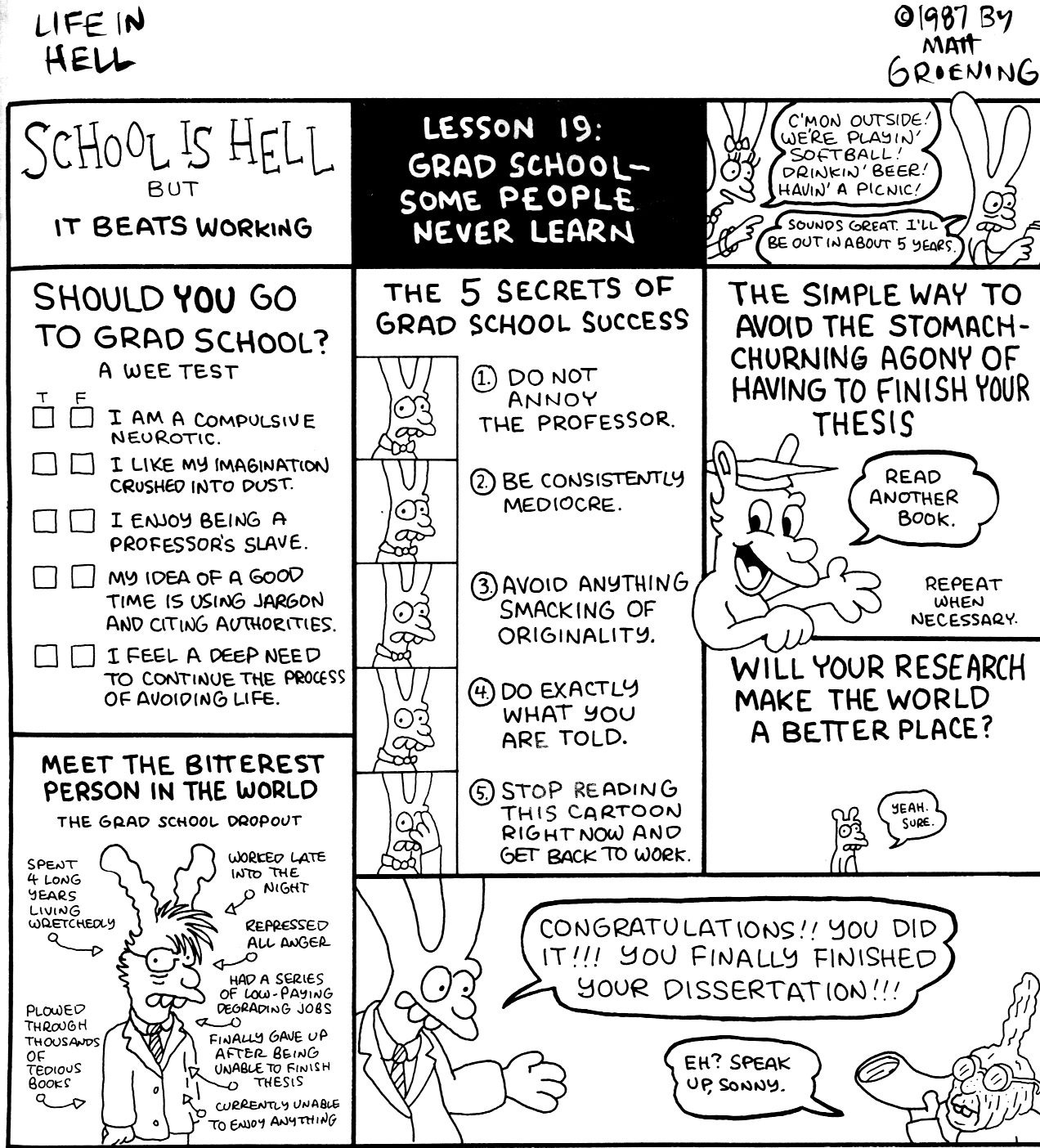
My current guess is that the set of people who should do a PhD is exhausted by
- People who are really remarkably chill and really want to become a “PI” (research lead)
- Love: People who are obsessed with their specific topic. You’d do it for free (you nearly are). We used to call them amateurs. Do not get a PhD in anything you are not obsessed with. Intrinsic interestingness, like AI, is a poor but workable substitute.
- Hermits: People who do not feel at home in society except in the regimented and half-real sanctuary of academia. (You should consider being a campus IT guru instead though, much less bullshit.)
- Rogue: People who need a basic income to work on their art or their startup or their basic understanding, while doing research on the side. Requires nerves of steel.
- Maybe a short stint for very arrogant people, to knock the stuffing out


Graveyard
Many of the best social scientists and statisticians have left academia, partly because real criticism is so unwelcome. In honour of:
- Tal Yarkoni
- Stuart Ritchie
- Michael Betancourt
- James Heathers
- Rex Douglass
- Richard McElreath
See also
- Brian Timar (2019), Mimetic
- Philip Guo (2012), The PhD Grind
- https://swopec.hhs.se/lunewp/abs/lunewp2024_005.htm
- Ethan Rosenthal (2019), https://www.ethanrosenthal.com/2019/02/12/liberal-physics-phd/
- Halperin https://x.com/BasilHalperin/status/1799138472969826523
- https://www.yuan-meng.com/posts/nothingness/
- https://nautil.us/what-does-any-of-this-have-to-do-with-physics-236309/
- https://x.com/BasilHalperin/status/1799138501356904652
- https://x.com/hyhieu226/status/1793686585067942142
- https://twitter.com/opinonhaver/status/1791158220846960912
- https://eiko-fried.com/antidotes-to-cynicism-creep
- https://www.goodreads.com/review/show/3025203866
- Piled higher and deeper
- phdiary
- ‘Methods Failing the Data, Data Failing the Methods’